Thursday, January 29, 2015

Week FOUR: Steady as She Goes

I'm just coasting along in the doldrums of winter, steady as she goes...

American Tree Sparrow
I concluded the third week of 2015 with an impromptu trip to Douglas County to see the Common Eider that was originally found in Minnesota waters on November 14, 2014. It recently moved over to Wisconsin when Canal Park in Duluth froze. From discussions I've seen on the web, this bird is apparently the Pacific subspecies. Dan Tallman gives a decent synopsis on the subspecies consideration for this bird and the assumptions on how this bird came to find itself on Lake Superior. It's rather an ugly duckling, but a world and Wisconsin state lifer for me nonetheless.  I met my friend Tom in Rice Lake and we drove to Superior to watch this bird at obliging distances while it fished for mussels.


On our way out of Superior, WI, we happen to be passing the Richard Bong Airport where several Snowy Owls have been reported. There are reportedly at least 10 Snowy Owls in Superior this winter. We eventually found one perched atop Menard's across from the airport. All the Snowy Owls in Superior get tagged and bastardized with black shoe polish which ruins any aspirations for getting quality images. However this was my first of the year Snowy Owl which gave it certain coolness factor. I'm curious what the person who paints these birds each year has learned from his research? I can't help thinking blackened Snowies have trouble getting dates.

Heading south from Superior I spotted this Porcupine next to Hwy 35 taking a snooze.


Making our way further south we visited Burnett County where I made a fourth effort at tromping around in the blown down spruce-tamarack bog in search an American Three-toed Woodpecker that has been inconsistently reported near Danbury, WI. I said I wasn't going to do that again! I've now totalled 11+ hours searching for this bird without success. However, it was an enjoyable time with one of my favorite birding companions.

Week three was also highlighted by this Merlin found at Jefferson Marsh in my home county of the same name. This species proved to be a nemesis for me last year in Jefferson County so I felt obliged to capture this crappy token image. It seems that's how it goes. The bird that alludes you in one year is often seen quite readily the next.


"Well here we go again, you've found yourself a friend that knows you well
But no matter what you do, it always feels as though you tripped and fell
So steady as she goes"
The Raconteurs

Wednesday, January 21, 2015

Weeks Two and Three 2015: Gulls, Blow Downs and a Owl

It doesn't seem like I've been birding that much, but when I look back on the past two weeks, I guess I have...sorta. As with most Januarys the thing to do if you're a birder in southern Wisconsin is find a dump or nice parking lot/outlot for gulling to pass the time...well that and chase rare owls (and bait them and/or repeatedly flush them trying to get a photo if you're real dick).

There's a Thayer's in there...
I happen to have a dump within 15 minutes of my house that attracts a nice variety of gulls during the winter months. Now gulling at the dump or in my case the outlot near the dump, is not much a nature experience, but I do enjoy the study of these birds during Wisconsin winters when there are a paucity of species to see in the state. However, I will tell you I've grown rather impatient with the whole Thayer's vs. Iceland nonsense. Any birder who takes photos to confirm on ID on these tricksters is met with scrutiny when submitting photos for feedback. "Did you get an open wing shot?" or " Hmm, I'd really like to see an open wing to be certain." Meanwhile those who bird without cameras go around cavalierly assigning species to these birds. When you're a member of good ole boys of club in the birding world, your word and what you saw is good as gold. Well I will never be a member of that club, but I am quickly migrating toward membership in the Fuck-it Club with these gulls. I simply refuse to spend an hour waiting for wing spread when I'm 99% sure from head shape, bill shape, mantle color, and amount of white and shade of blackness on the folded wing, that most of the gulls I'm looking at are Thayer's. Call me lazy. I prefer impatient, but I've decided once I get my Thayer's and Iceland for the year, all these gulls will simply go down as Thayer's/Iceland...unless it's an entirely obvious plumage... This was not the rant I was planning when I started writing this, but C'est la vie.

That's pretty much all this bird did...I say Thayer's


In recent weeks, the outlot by Kohl's offered all the regular Great Lakes gulls I can get reasonably hope to find this season. On January 16th I struck a sort of Gullapalooza. It was actually a GlaucousGullapalooza where I tallied a minimum of 12 birds! 


The Great Black-backed Gulls were gathered for a meeting as well, an uncommon species to find inland.


I also found my first-of-the-year Lesser Black-backed Gull (too tired to process a photo).

And finally the gem of the day this Kumlien's Iceland Gull...


On January 11th, I visited Observatory Hill State Natural Area to see the uncommon but regular annual visitor to Wisconsin, Townsend's Solitaire. This SNA really deserves its own blog post given it was one of John Muir's favorites, but alas that will have to wait.


I'm my way out of my driveway to see the solitaire, this Cooper's Hawk was perched above keeping watch on my feeders.


This past weekend took me to Burnett County on my second, third and final expedition to find the American Three-toed Woodpecker that's been seen on and off in a blown down bog off of  Bents Rd. FAIL. However the surroundings were serene, gray, monotone with the croaks of Common Ravens and nasal flight calls of Common Redpolls piercing the silence of winter. In other words, it was perfect (minus the part about missing the target species).

Common Redpoll

As a consolation prize, a couple of roadkills along Hwy 77 north of Danbury yielded an unexpected three Golden Eagles. They're another uncommon winter visitor to Wisconsin, one I've missed the past two years.


Finally, enroute back to southern Wisconsin, I decided to stop in Polk County to try for the recently sighted Northern Hawk Owl. Success. What a fine little owl. So dangerously unwary of humans...and no I didn't harass this visitor to get this shot.


Thursday, January 8, 2015

Week One 2015

Well I've made it through the first week of 2015. My blogging significantly dropped off late in 2014. I couldn't even muster the energy to talk about 2014's highlight for me, the female Rufous Hummingbird that visited my yard in southern Wisconsin for nine days in October. Perhaps one day soon I'll get around to talking about that golden experience.

In the interim I am pushing myself to make relatively effortless posts with just a few photos to highlight my week.

2015, will this finally be the year I... well nevermind, onto the highlights for week one...

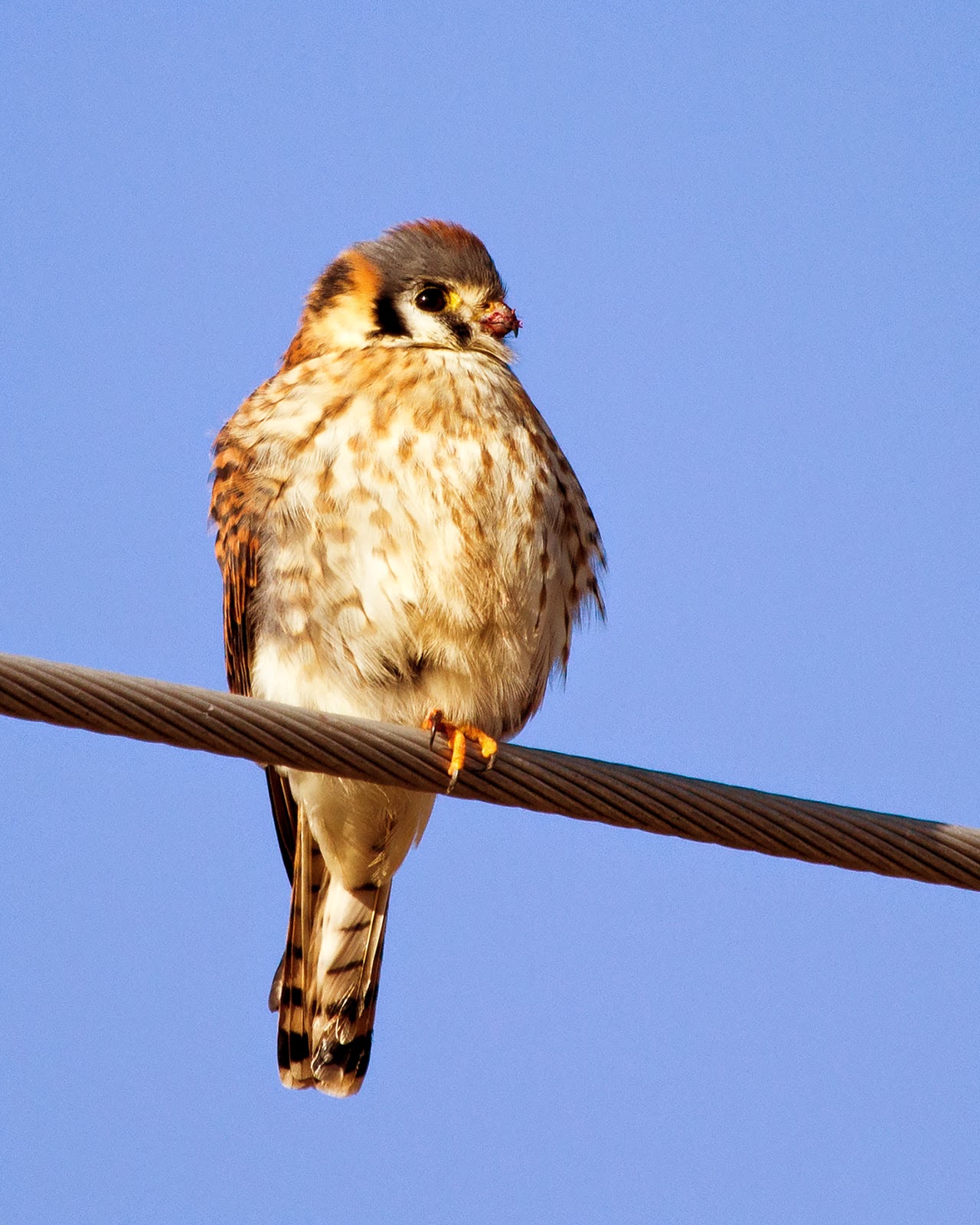
January 2nd brought well needed sunshine. I felt fortunate in having sun on my side during my first birding excursion of 2015. This cooperative American Kestrel and an uncommonly-seen-in-Wisconsin Western Red-tailed Hawk were fine sightings to start off my year.


I've been spending much of my birding time at the outlot next to Kohl's in Johnson Creek hanging out with a nice variety of gulls. Because what else is there to do in the winter in Wisconsin, but bird the gulls or harass owl? I'll opt for the former. My gull species list for the year already includes this nice adult Thayer's Gull. I waited over an hour for this bird to give me a wing stretch to clinch the ID.


I've been visiting Jefferson Marsh in the late afternoon and early evenings in hopes of finding a cooperative Short-eared Owl to photograph in sufficient light. FAIL. However I can't complain about the show these owls have put on, perching, hunting, vocalizing and interacting at close range during civil twilight. Sometimes the sun setting offers a nice prelude to the Short-eared Owl show. Though lately it seems the sun is a rather rare sighting.

Jefferson Marsh
Familiarity can be quite comforting, This particular Barred Owl, a recognizable inhabitant of Pheasant Branch Conservancy, put a bright spot in what felt like a dark week.


It's onto week two. It feels like it's going to be long winter and even longer year. Forward for now.


Saturday, November 15, 2014

15November2014


ever so elegantly
the season is changing
snow
beautiful 
and light


Sunday, November 9, 2014

North Point Sheboygan WI

Sometimes I don't think I have it in me to do this blogging thing. However if I don't post at least SOME of my photos, I'm left to wonder why I keep capturing images simply to fill up hard drives. I had a lot going on in October and should have chronicled some of it here. Alas life was happening which prevented me from spending too much time on screens (a good problem to have). Hopefully I will get around to posting at least some of my fall forays in the coming weeks. For now, I'll start with today...

North Point, Sheboygan, WI
North Point, Sheboygan, WI... I have to say it's one of my favorite places for waterbird photography, especially in the late afternoon.  It's perhaps one of the few places where I find gulls to be beautiful versus the dirty scavengers they are. Despite it's urban setting, I can expend hours absorbed with capturing images of gulls and waterbirds against the Niagra limestone bedrock and azure blue waters of Lake Michigan. Some of my favorite birds seen from this point include crushing looks at Little, Laughing and Bonaparte's Gulls, White-rumped Sandpiper, Barrow's Goldeneye and the currently occurring Harlequin Duck.

Harlequin Duck, DSLR

Harlequin Duck, DSLR
 Typically, one to a few Harlequin Ducks are seen in Wisconsin late fall through early winter on an annual basis. A few days ago, one was reported at North Point in Sheboygan. Since I had a class nearby this morning, I seized the afternoon opportunity to behold this colorful male.

Harlequin Duck, digiscoped

Harlequin Duck, digiscoped
I challenged myself to try my hand at digiscoping this bird that was constantly moving and diving along the rocky shoreline. While my results weren't perfect, it was good practice trying to locate, manually focus and shoot a moving target. Digiscoping takes far greater patience than using a DSLR. I own both. While the DSLR is far easier to shoot with, digiscoping allows for greater reach and sometimes the results can yield some amazing detail. I also prefer the color results I get digiscoping with my Nikon V1 as opposed to my Canon DSLR.


I've been enamoured lately with the Great Black-backed Gulls at North Point . In digiscoping them, I've come to realize they have black toenails.


For that matter so do Herring and Ring-billed Gulls. A quick check of my Gulls of the Americas guide shows all the yellow and pink-legged gulls have this feature. This has me wondering about how many other birds have contrasting black toenails. I know Ruffs do. None of my Sibley eGuide illustrations show this feature on any of the birds previously mentioned. However, kudos to the National Geographic Field Guide to the Birds of Eastern North America, they got the toenails correct! I know most would think, "who cares about the toenails." I'm rather taken by this feature and am feeling moved to make a list of all the birds I observe with goth toenails. After all that's what we birders do, make lists.

"Do not make eye contact" thinks the Herring Gull


Sunday, October 5, 2014

Ruby Delights

I spent the weekend in the company of this presumed hatch year (HY) male Ruby-throated Hummingbird. 


I had been resigned to thinking my feeders would no longer host anymore hummingbirds for the year when two appeared in the yard on Friday afternoon. I spent time photographing and digiscoping one of the birds which I concluded was likely a hatch year male. While aging Ruby-throated Hummingbirds in the field is challenging since seeing bill corrugations (the reliable method for aging) requires microscopic views, several features lead me to believe the bird in question is a HY male. For starters, the bird had two red-gorget feathers on the throat which nearly always is a indicative of a HY male. Secondly, the head and body feathers were buff-edged which is associated with HY birds of this species at this time of year. 

Ruby-throated Hummingbird showing 2 red gorget feathers
Showing the buffy edged head feathers during preening

Generally speaking, caution should be employed in attributing age and sex to Ruby-throated Hummingbirds during late summer and fall via field observation. By October, the full red-gorgetted adult males have long left the state with most if not all birds falling into the nebulous female/hatch year category. While it is generally true, birds with minimal to no dusky markings on the throat are likely females this feature is not the sole determining factor for sex per my banding training with the Great Lakes HummerNet team led by Allen Chartier. Furthermore, while a few red gorget feathers often point to a bird being a HY male, Pyle notes in the Identification Guide to North AmericanBirds, occasional AHY females can have one to a few iridescent red feathers in the throat. Hence the waters of age and sex become quite muddy when observing this species in the field during late summer/fall.

Bill corrugations (wrinkles on bill) ~90% of bill in this example indicate HY bird

Throat pattern on a HY male RTHU
When banding, once age is determined by bill corrugations (wrinkles on the bill), for a HY bird sans the red gorget feathers, often the wing cord and culmen measurements are sufficient for determining sex. The males are shorter on both measurements. When these measurements fall in an overlap range between the sexes, the shape of primary 6 (p6) is used to determine the sex. On a HY male Ruby-throated Hummingbird, p6 is attenuated to sharp point and the outer vane is quite narrow. This is seen well in the digiscoped images I captured of my weekend visitor (see image below). However note in an AHY female, p6, though less pointed is quite similar. In contrast a HY female’s p6 is rounded at the tip with the outer vane being wider.

Attenuated p6 on my weekend visitor
Another characteristic to consider in separating HY males from HY females is the shape of the outer retrix (r5). HY males have a more tapered outer retrix.  In the absence of knowing he bird’s age, again there is overlap in the outer retrix shape of a HY male versus AHY female. Same goes for throat pattern. Not all HY males will have red gorget feathers and as noted above, some AHY females can actually have one to a few red gorget feathers. Hence the earlier caution stands, in the absence of knowing the age of a Ruby-throated hummingbird (most reliably determined by bill corrugations under magnification), Ruby-throated Hummingbirds that are not AHY males with full red gorgets should typically be left identified to species only in the field. However with careful observations and photographs one may be able to age and sex.

Somewhat attenuated outer retrix
Shape on the weekend visitor is consistent with HY male or AHY female
But back to my visitor which I’m calling a "he" since after handling a couple hundred Ruby-throated Hummingbirds this summer, I feel fairly confident this is a young male. He spends most of his down time in the Washington Hawthorne. It’s both close to some of the preferred feeders and is great cover with its 1-2 inch thorns that offer some protection against avian predators like the local Cooper’s Hawk. Though I’m not sure a Cooper’s would be satisfied with a measly hummingbird meal that is the equivalent weight of a penny.

Hanging out in the Washington Hawthorne


Washington Hawthorne
While others in Wisconsin report their hummingbirds preferring flowers and bugs over nectar feeders in recent days, mine fed consistently on the feeders all day Saturday. Infrequently I saw him foraging for insects in our large pine tree and once nectaring on the Turtle Head and Anise Hyssop.  


Despite the cold temps in the mid 30s the bird still mustered the energy on Saturday to chase away one of the resident Chickadees on several occasions.  It was nice to have this little distraction between chores when my desire to go out on some major birding foray in the cold damp weather was lacking. Time will tell if the little bugger will be here tomorrow.

I’m still holding out hope, with seven feeders cleaned and refreshed every 2-3 days, that a vagrant hummingbird will find its way to my yard this year!

Wednesday, October 1, 2014

October Begins...

Mother Nature delivered up perfection this eve as I closed out the first day of October, my favorite month of the year. The sky was mostly cloudy as I walked due west from the parking area at Paradise Valley State Wildlife Area in search of suitable shorebird habitat.  I walked until the path petered out into a mudflat at the water's edge of the marsh.
Paradise Valley State Wildlife Area, Waukesha Co., WI
I found a lone obliging Black-bellied Plover that I observed for a few minutes. However, soon the setting sun captured my attention when it came piercing out between a break in clouds, throwing warm red-orange light across the marsh in complimentary reflections.


After taking in my fill of the setting sun, I returned to my former engagement, digiscoping a Black-bellied Plover in challenging, but also mesmerizing light.


As the sun made its final descent below the horizon, a Great Horned Owl started the evening serenade with its low "who-who-who who-who." Out of the western civil twilight sky, groups of Great Egrets and Black-Crowned Night Herons streamed over me into the marsh. The night herons called out in their hoarse croaky "woks" while sparrows seeped and chipped.  The scene was exhilarating and perfect.

As I walked back to my car in the fading twilight, my heart felt full and light. I nearly had myself convinced that this, nature, was all I needed. Nature is seemingly powerless to disappoint. In fact, it is everything to the contrary.