Thursday, June 30, 2016

Common Nighthawk

I have lived at my home in Jefferson County, Wisconsin since July 2005. I can't remember a summer evening without at least one pair of Common Nighthawks peenting and booming among the din of summer sounds.


In fact in 2009, I returned home to find a Common Nighthawk roosting on a dormer of my house.


Fortunately, this summer is no exception to my trend of having an annual backyard Common Nighthawk. Although my resident Common Nighthawk seemed to have arrived later this year. It wasn't until June 6th, I was confident I was finally seeing and hearing my resident male as opposed t migrants. He had been flying low over my house doing his peenting/booming routine. His aerial displays have continued nightly.

Throughout most of June, I have only heard or seen a single bird. Common Nighthawks are regarded to be in sharp decline, so I was becoming concerned he would go unmated this year.


I have grown into the habit of never taking for granted the sight and sound of Common Nighthawks precisely because of their conservation status. The 2014 State of the Birds listed Common Nighthawk as a common species in steep decline and this year's State of North America's Birds lists Common Nighthawk at a moderate conservation concern level with a continuing population trend of being in steep decline. Of note though Common Nighthawk did not make the 2016 "Watch List." In examining the data I was actually rather stunned by the number of regularly occurring Wisconsin bird species that did!


Last night my concerns at least for this one particular backyard Common Nighthawk were allayed when I observed a pair in synchronous flight. They were peenting to softly to each other in a manner that led me to believe they were pair-bonding. The peents were shorter and of less intensity than I've observed with single birds. I am hopeful the July sky will include their offspring. 

Wisconsin Bird Species Watch List adapted from the State of North America's Birds 2016


The following is a table of Watch List Bird Species occurring in Wisconsin that I adapted from the North American Bird Conservation Initiative's (NABCI) State of North America's Birds 2016. According to the NABCI's study, species were assigned concern scores ranging from 4-20 with 20 being a score of greatest conservation concern and 4 being relatively widespread, secure species. Details on their methodology can be found here

The Watch List is comprised of species with concern scores of 14 or higher, or with a concern score of 13 and a steeply declining population trend. It reflects "the species most at risk of extinction without significant conservation actions to reverse declines and reduce threats." 

Specific to this adapted table, I included species I know to have been found in Wisconsin within the last 5 years. The species in bold are those that occur on a regular annual basis in Wisconsin, albeit some are rare regular (small numbers occur annually). That's 40 species seen regularly in Wisconsin at risk of extinction! 

English Name
Scientific Name
Breeding Habitat
Concern Score
Greater Prairie-Chicken
Tympanuchus cupido
Grasslands
16
Ivory Gull
Pagophila eburnea
Coasts
16
Kirtland's Warbler
Setophaga kirtlandii
E. Temp. Forest
16
Whooping Crane
Grus americana
Boreal Forest (Wet)
16
Yellow Rail
Coturnicops noveboracensis
Wetlands
16
Buff-breasted Sandpiper
Calidris subruficollis
Tundra (Wet)
15
Cerulean Warbler
Setophaga cerulea
E. Temp. Forest
15
Chestnut-collared Longspur
Calcarius ornatus
Grasslands
15
King Rail
Rallus elegans
Wetlands
15
Lewis's Woodpecker
Melanerpes lewis
W. Temp. Forest
15
Marbled Godwit
Limosa fedoa
Wetlands
15
Piping Plover
Charadrius melodus
Coasts
15
Bobolink
Dolichonyx oryzivorus
Grasslands
14
Canada Warbler
Cardellina canadensis
Boreal Forest
14
Common Eider
Somateria mollissima
Coasts
14
Eastern Whip-poor-will
Antrostomus vociferus
E. Temp. Forest
14
Henslow's Sparrow
Ammodramus henslowii
Grasslands
14
Hudsonian Godwit
Limosa haemastica
Boreal Forest (Wet)
14
Kentucky Warbler
Geothlypis formosa
E. Temp. Forest
14
Little Blue Heron
Egretta caerulea
Wetlands
14
Nelson's Sparrow
Ammodramus nelsoni
Wetlands
14
Prothonotary Warbler
Protonotaria citrea
E. Temp. Forest
14
Rufous Hummingbird
Selasphorus rufus
W. Temp. Forest
14
Semipalmated Sandpiper
Calidris pusilla
Tundra (Wet)
14
Short-billed Dowitcher
Limnodromus griseus
Boreal Forest (Wet)
14
Surf Scoter
Melanitta perspicillata
Boreal Forest (Wet)
14
Willet
Tringa semipalmata
Wetlands
14
Wood Thrush
Hylocichla mustelina
E. Temp. Forest
14
American Black Duck
Anas rubripes
Boreal Forest (Wet)
13
American Woodcock
Scolopax minor
E. Temp. Forest
13
Band-tailed Pigeon
Patagioenas fasciata
W. Temp. Forest
13
Black Scoter
Melanitta americana
Tundra (Wet)
13
Black-billed Cuckoo
Coccyzus erythropthalmus
Boreal Forest
13
Cape May Warbler
Setophaga tigrina
Boreal Forest
13
Connecticut Warbler
Oporornis agilis
Boreal Forest
13
Evening Grosbeak
Coccothraustes vespertinus
Boreal Forest
13
Harris's Sparrow
Zonotrichia querula
Tundra
13
Horned Grebe
Podiceps auritus
Wetlands
13
King Eider
Somateria spectabilis
Tundra (Wet)
13
Lesser Yellowlegs
Tringa flavipes
Boreal Forest (Wet)
13
Long-eared Owl
Asio otus
Forest Generalist
13
Olive-sided Flycatcher
Contopus cooperi
Boreal Forest
13
Pectoral Sandpiper
Calidris melanotos
Tundra (Wet)
13
Prairie Warbler
Setophaga discolor
E. Temp. Forest
13
Red-headed Woodpecker
Melanerpes erythrocephalus
E. Temp. Forest
13
Snowy Owl
Bubo scandiacus
Tundra
13
White-winged Scoter
Melanitta fusca
Boreal Forest (Wet)
13


Saturday, June 4, 2016

May's Many Faces: May 20th

As usual I've been out and about amassing photos and getting behind on doing much of anything with processing or sharing them. I'm struggling this spring to capture sharp photos. It first began with faulty repairs to my Canon 100-400 mm zoom lens resulting in some misalignment and blurry images. Canon supposedly corrected this issue, but now I'm struggling to achieve sharp results with my fool proof 100mm macro lens. I'm left wondering if the image stabilization works on either lens or am I just failing miserably at keeping a steady hand when capturing images. I'm feeling rather frustrated by my results especially my recent efforts with tiger beetle photography. I thought I nailed it being face to face with a few specimens the other day, only to discover the sharpness of my images considerably lacking.

Oblique-lined Tiger Beetle, Sauk Prairie Recreation Area, Sauk Co 3June2016
Despite feeling braced and steady during capture, I had to process with shake reduction due to shitty results.
Adding to my photography struggles, the end of May left me down approximately $300 worth of gear with the loss of my Blue Mikey Condenser Microphone ($100) on May 20th at Quincy Bluff State Natural Area and the loss of my 430 ii Canon Speedlite flash at Spring Green Preserve four days later ($200). I'm having one helluva spring!

Quincy Bluff SNA, July 2015
 Anyway, back to May 20th as I play catch up. I ventured to Quincy Bluff and Wetlands State Natural Area in Adams county for my first effort at tiger-beetling this year. I discovered this site late in the season last year when I looking for areas to find lifer tiger beetles.

Quincy Bluff SNA, July 2015
The birds, rock formations and insects were intriguing enough to inspire my return. In fact with Adams County being quite sandy, I want to focus more of my tiger-beetling efforts here this year. I feel I have a greater chance of adding a new species to my list from this more northern county versus Sauk or Jefferson Counties where I have focused my past efforts. Plus with the rise in popularity of Spring Green Preserve, a favorite haunt of mine for herps, insects and plants, I feel it's time to explore elsewhere. Though admittedly, the lure of that place keeps calling me.

Adams County Sand Blow

Adams County Sand Blow
I was hoping for the Northern Barrens Tiger Beetle which the Wisconsin DNR reports are found here. This state natural area is quite expansive. I may be looking in the wrong area or at the wrong time as I have yet to find this species. In fact Festive Tiger Beetle was the only species I found. From my visit last year, I know Punctured and Big Sand occur here as well.

Festive Tiger Beetle digging
Lyre-leaved Rock-cress, Lupine, Bird's Foot Violet and Puccoon were all in bloom. So I had plenty to keep me busy with trying to capture the various butterflies using these plants.
Lupine


Juvenile's Duskywing
Rock-cress is a primary host plant for Olympia Marbles, so it's no wonder a fair number of these were flying in the area.

Lyre-leaved Rock Cress
They were much easier to capture toward dark when they were found roosting on the as opposed to frenetically nectaring and in near constant flight.

Olympia Marble
Where I had found the roadsides covered with more Prairie Fame-flower than I've ever seen before last summer, I now discovered roadsides covered with more Birds-foot Violet than I've seen.

Prairie Fame-flower, Quincy Bluff and Wetlands, July 2015
Bird's foot Violet, Quincy Bluff and Wetlands, 20May2016
I was tipped off to the uncommon Ringed Boghaunter occurring at this location. I am not much of an odonatologist and struggle with dragonfly identification, but this species was fairly easy to pick out.

Ringed Boghaunter
I found a few other dragonflies which I claim no accuray on identity.


Since I arrived in the heat of the afternoon, bird activity was not remarkable. However I did observe copulating Red-headed Woodpeckers, found a nesting Hairy Woodpecker and found one of our later migrating warblers, a male Blackpoll.

Despite my trials with lost equipment, camera and lens woes, and self-doubt about my ability to capture sharp images, it's been a good spring with many more cool observations to share!

Wednesday, May 18, 2016

Remains of the Day

Yesterday I greeted the day apologizing to the birds for my having missed their finest hours, those first few in first light. These buoyant colorful creatures made another fine showing while I remained roosting under comforters and within the comforts of my mind.

My nocturnal habits and dress are clearly much more suited to the owls and nightjars. However darkness is hardly conducive to capturing any worthwhile images.

I intentionally scheduled work for the afternoon to allow bird time in the prime morning hours. Yet when that alarm sounded, the back of the my eyelids felt more magnetic than the lure of neotropical migrants.

Cerulean Warbler, male. Carlin Trl, Jefferson Co

With what little bird time remained of my day, I did manage to sneak in a quick stop along Carlin Trail in the Southern Kettle Moraine where Cerulean and Hooded Warblers, and Acadian Flycatchers breed. By late morning, no Hooded Warblers were observed. However both Acadian Flycatcher and Cerulean Warbler were present and quite vocal.

Cerulean Warbler (female) playing peek-a-boo
The Cerulean Warblers were numerous and traveling in pairs, singing and getting on with the business of procreating. They left me longing for more... and perhaps with some regret for not rising enthusiastically to the greet them at the beginning of this day.

Peek-a-boo female Cerulean Warbler, S. Kettle Moraine 18May2016


Sunday, May 15, 2016

Dwindles

Today I found myself on the downside of what I've dubbed spring migration dwindles. It's essentially the parallel of dwindles in geriatric patients but applied to my experience with birding.

Harris's Sparrow, Lake Farm Park, Dane Co 15May2016
I returned to Lake Farm Park in Dane County to photograph a stunning male Harris's Sparrow. I should have been elated. We rarely see this species in the adult male plumage in this part of the world. The bird perched in nice sunlight, singing at periodic intervals. I felt crushed and crushing on all fronts. Yet the exuberance of seeing my first breeding male in Wisconsin quickly dissipated into the birding dwindles that had taken hold of me earlier in the day, perhaps even last eve.

Harris's Sparrow, no photo awards here. But I like this view of him!
 Lake Farm Park, Dane Co, 14May2016
I couldn't spend much time with the bird this day (long story of bad directions).
Hence my return May 15th for more photos
Great-crested Flycatcher, Pheasant Branch Conservancy, Dane Co 15May2016
It all began May 11th. Well maybe before... Anyway I'm starting with May 11th... After a lackluster showing of migrants earlier in May, the winds shifted out of the south Tuesday evening (May 10) into Wednesday (May 11). The floodgates opened and we experienced a mini bird fallout here in southern Wisconsin. I was utterly and blissfully lost in birding the entire day, unable to get enough of seeing the warblers and other neotropical migrants. I hit it hard that day. Photos were hard to come by as the day was mostly misty with poor lighting and there was simply too much activity to pause for photos.

3:48 AM radar 11May2016

Prothonotary Warbler, UW Aboretum, Dane Co, 11May2016

That's not a bird! Pheasant Branch Conservancy, Dane Co, 11May2016

Red-tailed Hawk devouring a small mammal, UW Arboretum, 11May2016
Good birding persisted the following day, though not on the dripping level of the prior day. Hung over from the previous day, like a good addict nursing a Bloody Mary the day after binge drinking, I eased into birding from my measly .2 acre backyard where I was treated to migrants working their way through my little green oasis of mostly native plants and trees. The highlight of my visitors were three Cape May Warblers who remained in my backyard for the hour I nursed myself back into birding.

Cape May Warbler, my backyard, Jefferson Co, WI 12May2016
Blue-Gray Gnatcatcher, nest building, Bark River Park, Jefferson Co 12May2016
Every day since the mini fallout, I debate with myself as to whether it will be a birding-worthy day. I negotiate the value of sleep versus birding versus work. I follow the birding groups on Facebook checking to see what's around. I go through phases of bird envy and self-loathing for even caring what others might be seeing. I check the radars around 11:00 pm and then again around 4:30 a.m. factoring them into my "to bird or not" decision. But bird I do, pretty much every day.

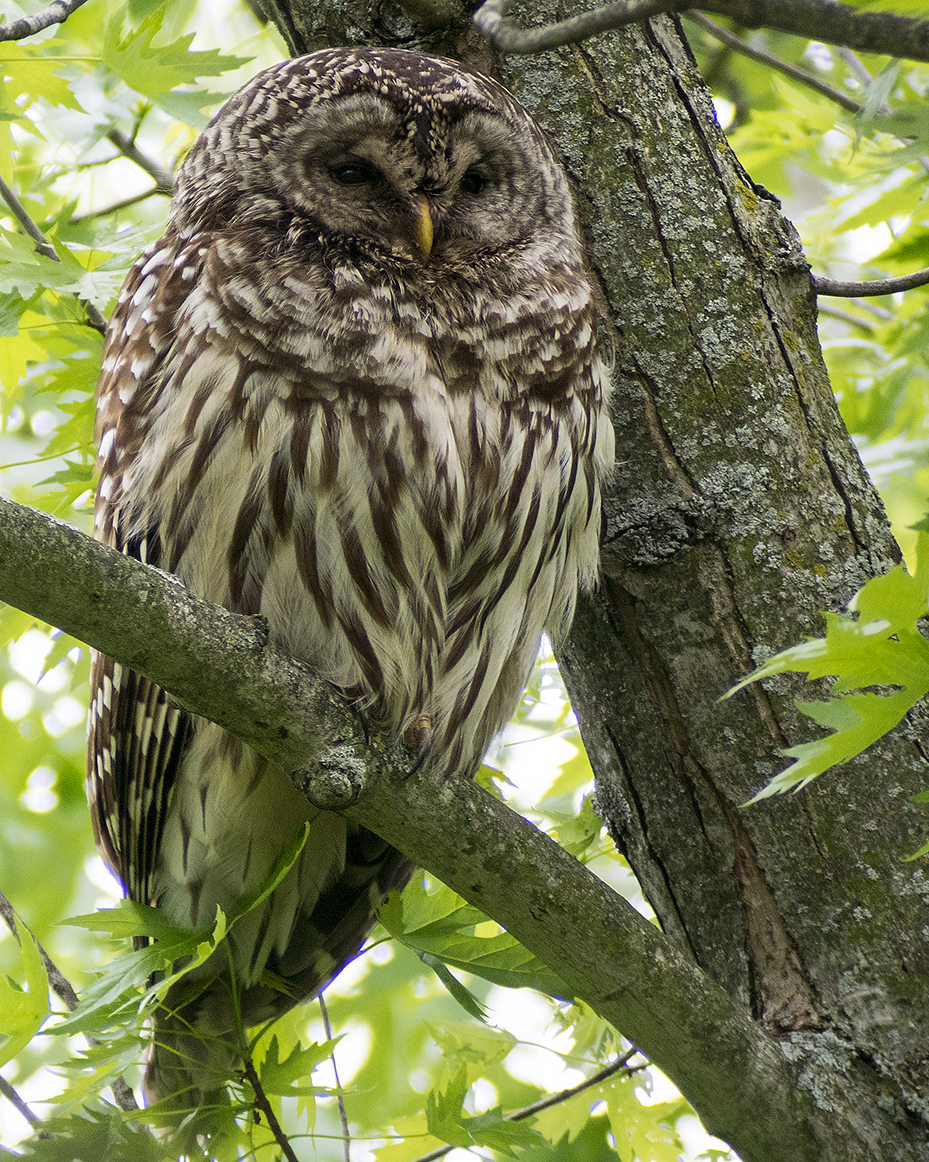
Barred Owl, Jefferson Co, WI 14May2016
The migrants have continued in spurts, some days better than others. Birds have seemed held up again by the past few days of north winds including a freeze warning last night. The culmination of the obsessive planning, looking, wondering, walking, hiking, driving and other personal trials are taking a toll on my enthusiasm for birding. And the darn wind the past two days, have I mentioned how much I loathe birding in blustery conditions? ANNOYING!

Marbled Godwits (foreground), Jefferson Co, 8May2016
I continue to see new year birds daily. In the past week I've found Marbled Godwits, a Willet, and Short-billed Dowitchers in the flooded ag fields in my podunk town in southern Wisconsin. Just yesterday I saw two Whooping Cranes in my home county of Jefferson. I've seen a White-faced Ibis in Dane county, a rare but annually regular bird in the state. I've seen Barred Owls both close and far on several days. My eyes have witnessed colorful warblers at eye level as well as those unfortunate distances high in the canopy (booo warbler neck).

White-faced Ibis with American Coot, Nine Springs, Dane Co, 13May2016
I should be happy. I should be in a state of perpetual birding bliss. However plain and simple, I've hit a brick wall. Maybe it's time for a break. (In the middle of spring migration! WTF?!)

Blackburnian Warbler, comes down for a bath, Pheasant Branch Conservancy, 15May2016
I began this conversation with myself while out today about how I've amassed a shit ton of photos over the past week. I started stressing about processing them, began to question the purpose of taking photos and sharing photos. I went as far as to put the brakes on visiting a state natural area today because it would only mean more photos to process. Ugh.


Northern Waterthrush, Lake Farm Park, Dane Co, 15May2016
The dwindles. I'm telling you I have a bad case. Birding and birder exhaustion. As fun as it can sometimes be, there is definitely the fatigue of coping with birder dynamics. The increased socialization (if you want to call it that) with birders during this time of year is equally if not more draining than the birding. But I would be lying if I said I didn't enjoy seeing birding friends as opposed to the isolation I experienced this past winter.

Palm Warbler, Lake Farm Park, Dane Co, 15May2016
So I ask myself, do I even want to do this anymore? The photos, gobs of photos. Does posting them make me appear more interesting? Does that matter? Nature photos are PROLIFIC everywhere on the internet. I'd like to say I'm doing it better or different, but I'm not. Average. It's all just average. There are some who do this, the blog thing, who are great at it. The whimsy and philosophy of their experiences, their stories, are worth the clouds they float in. To them I say, keep on keeping on. Do what you love. Love what you do. For me, perhaps I should learn how to play an instrument or get back into my art. That might be more compelling. Hmm. Would it?

Veery looking like an antpitta, Lake Farm Park, Dane Co, 15May2016
Dwindles, I'm on a roll dwindling. I cannot deny the greatness of the ups. But they do always come with the downs. Birding after all can be an addiction. As such, highs and lows are an inherent risk. BEWARE.
Chestnut-sided Warbler, Pheasant Branch Conservancy, Dane Co 15May2016