Just a little over a week ago, I decided to check out a birding location new to me, the southern section of Koshkonong State Wildlife Area. I had often driven by this spot along Koshkonong Mounds Road and suspected these grasslands could be good for sparrows. The DNR website describes this particular habitat as oak savannah. In addition to the savannah, the perimeter consists of a mix of fruit bearing shrubs, pine stands to the south, old growth deciduous forest to the north and ag fields to east. While songbird diversity is generally low this time of year, I've been impressed with the number of birds seen at this location. The edge habitat along the grassland has proven to attract good numbers of migrant songbirds over the course of my three visits in the past week.
On my most recent visit (October 22) both kinglets were numerous. I spent a bit of time being entertained by this particular Ruby-crowned Kinglet.
Ruby-crowned Kinglet
Several Hermit Thrushes and American Robins were feasting on a variety of fruiting shrubs.
Hermit Thrush
This particular fruit, possibly a crab apple was a favorite of the robins.
A week ago the Yellow-rumped Warblers were coming through in peak numbers and feeding on the copious amounts of poison ivy fruit.
Yellow-rumped Warbler eating Poison Ivy fruit 10/15/2013
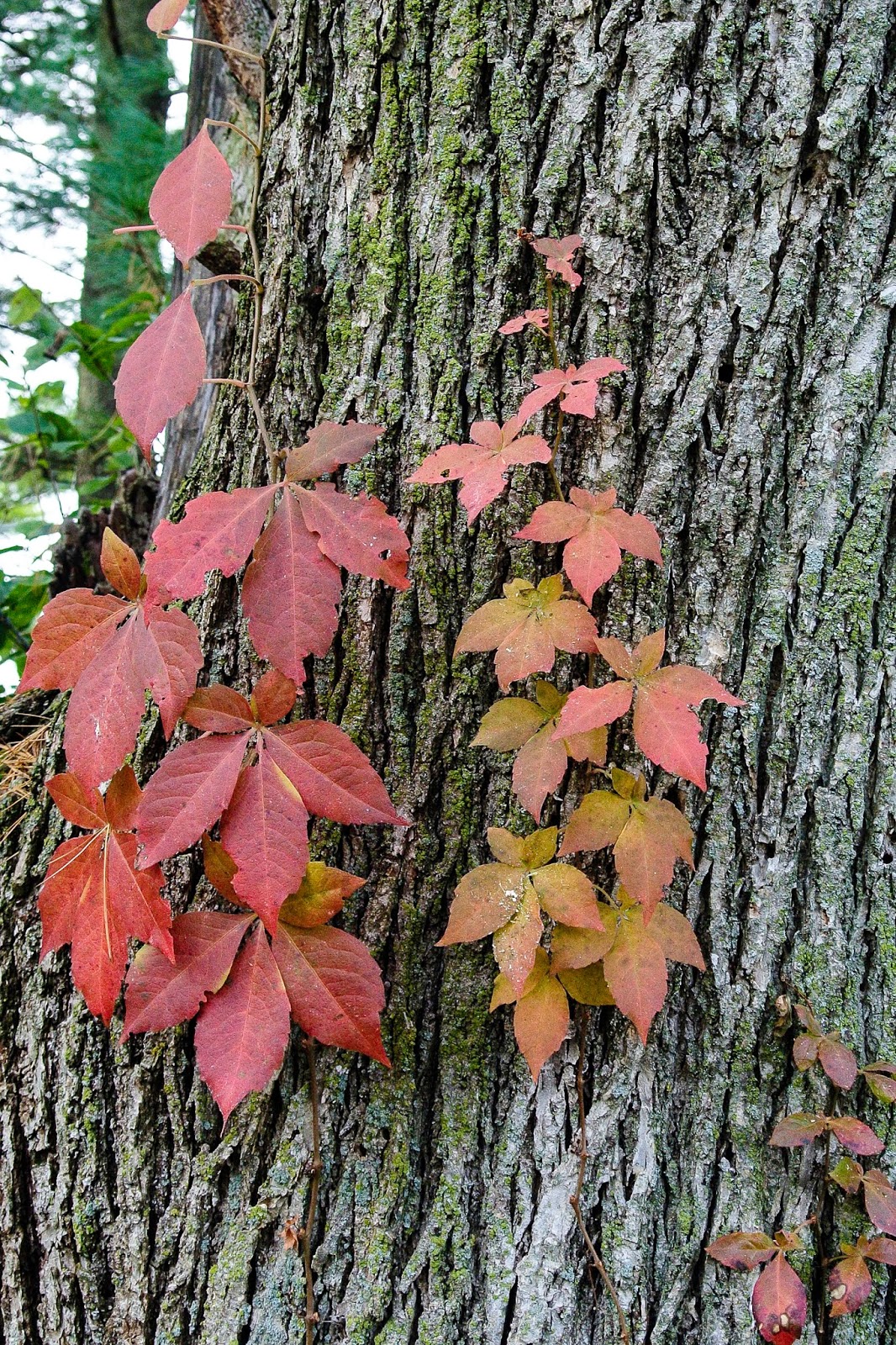
Those vines were stripped clean by October 22nd.
Poison Ivy Vine 10/22/2013
I was surprised to find a Sedge Wren quietly traveling with a Common Yellowthroat. Both are considered late sightings for October 22nd.
Sedge Wren
While generally speaking, sparrow diversity and numbers are decreasing, Dark-eyed Juncos and Fox Sparrows are on the increase.
Dark-eyed Junco, male
White-crowned sparrows are still present. Most birds observed have been hatch years.
Hatch year White-crowned Sparrow
I managed to find a lone Lincoln's Sparrow toward the end of my 3 hour walk. I suspect this may be the last one I see at this location.
Lincoln's Sparrow
Brown Creeper's were quite active, but with poor lighting and their frequent movement, I couldn't manage a reasonable photo.
Despite the freezing temperatures, a few dragonflies and other flies still managed to persist.
While I spent the majority of my time birding the edge of savannah, I did venture into the forest for a short while where I found a single persisting Tall Bellflower in bloom.
Tall Bellflower
Dunna-dun-dun-dun another one bites the dust...Something enjoyed a Blue Jay for its meal.
Blue Jay feathers
Total species for my 3.5 hour outing on October 22nd was 33 which seems somewhat low. However the number of birds present provided me plenty of entertainment.
Some birders in Wisconsin might consider Wisconsin Point the end of the rainbow in terms of the quality of birding. For the most part, I would have to agree. Wisconsin Point definitely seems to harbor its share of highly sought after birds. For me, pretty much any time I find myself by the shores of Lake Superior it seems I'm near that ethereal pot of gold. Although the industrial waters near Superior, WI don't quite measure up to pristine shores in eastern Upper Peninsula, there's still much to draw me to the southeast corner of Lake Superior at least a few times each year. Without a doubt, sunrises are still spectacular in this corner of the lake and the weather put up by Lake Superior makes for some visual delights regardless of where I might find myself along its shores.
The Wisconsin Society for Ornithology's Jaegerfest is one reason I've been visiting Wisconsin Point the last several years. While I don't want to rehash the details of this fun weekend as others have provided an excellent summary of the trip, here are few moments I treasured from this year's event.
The jaegers were plentiful both in quantity and quality! In some years past, we have been lucky to see a single distant Parasitic Jaeger during the three day trip. This year jaegers abounded daily with endless aerial displays. The number of individual birds was surmised to be at least 6 on the first official day of Jaegerfest!
Parasistic Jaeger, sub adult
Parasitic Jaeger chasing a Ring-billed Gull
"Notch" the Parasitic Jaeger of notoriety present since late August
With recent sightings of Long-tailed Jaegers in late August and early September, I came to Jaegerfest with the hope that I would encounter this species to add to my Wisconsin life list. Quite handily, my first day at Wisconsin Point, I was fortunate to see and photograph a juvenile Long-tailed Jaeger called out by trip leader, Tom Schultz. Before we came to ID this jaeger as a Long-tailed, Erik Brunke and I were on it taking photographs as it was uniquely quite darker than any jaeger we had seen for the day. This was Wisconsin year bird 301 for me.
Long-tailed Jaeger, juvenile
Long-tailed Jaeger, juvenile
Then greed set in, as if seeing one Long-tailed Jaeger on the Great Lakes wasn't enough I began to crave a look at the nicely plumaged subadult that others had reported.... Luck would have it when later in the weekend, the subadult Long-tailed Jaeger gave great looks as it lazily flew right over the crowd of birders at the Lot 1 beach. Cheers went out from the elated group. We were all in awe of the stunning views. The joy of the moment was infectious providing reinforcement to the reasons why I gravitate toward the social aspects of birding, good times, good birds, good people.
Long-tailed Jaeger, sub-adult
Long-tailed Jaeger, sub-adult
Although some of us in early attendance were fortunate to see a Sabine's gull on Thursday, the majority of the Jaegerfesters got their Sabine's Gull Sunday when one flew in late to the party on the last day of Jaegerfest. To our delight it landed on the water near shore providing stunning views when it took flight (Recommend setting video to HD at bottom right).
Sabine's Gull
As I alluded to earlier, these group birding trips are just as much about the people as the birds. Jaegerfest is a reunion of sorts and a fun opportunity to bird, eat and drink with new and old friends.
There are veteran faces that seem integral and symbolic to what Jaegerfest has come to represent for me. Here are some of the cast of Jaegerfest characters...
Our humble and exceptionally knowledgeable trip leader, Tom Schultz...
Tom Schultz
Daryl Tessen, an original jaegerfester and veteran birder who makes Jaegerfest into a week long trip.
Daryl Tessen
Robbye Johnson, resident Superior, WI veteran birder and all around cool person. She's been celebrating with the jaegers from the beginning!
Robbye Johnson (right)
Ty and Ida Baumann....Ida handily spotted the Sabine's Gull that flew in and landed on the water the last day of Jaegerfest...Thanks Ida for your keen spotting!
Ty and Ida Baumann
Jerry Smith (this guy knows how to have good time)....Big thanks to Jerry this year for putting out seed at his RV site and drawing in the only Harris's Sparrow I've seen in Wisconsin this year.
Jerry Smith
It's always a treat to catch up with my fellow WI eBird teammates Nick Anich and Ryan Brady (not pictured) when I make it up to the northwest corner of Wisconsin. And of course, I have many treasured Jaegerfest memories I've shared with two of my favorite traveling birder buddies, Tom Prestby and Tim Hahn.
Hear no evil, see no evil...Tom Prestby, Nick Anich and Tim Hahn
Friday's line-up with buddy, Erik Brunke another fixture to the Jaegerfest scene. Salutations to all the jaegers!
Brunks, pictured second from the right. "Salut to all things jaeger!"
Peter, Lisa, Kyle and Lindsey. Lindsey is happily making her way through clouds of mosquitoes.
On July 20-21, 2013, a small group of Madison area birders met at a friend's Wisconsin River property southwest of Sauk City for what was dubbed Bird Camp. The intent was to gather for some leisurely birding, camping and food and drink around a campfire. Arriving mid-afternoon, one thing became apparent, the mosquitoes were going to be insane! While there was some relief in the sun, even during the hot afternoon, any time spent in the shade was met with swarms of mosquitoes.
I took the opportunity before other friends arrived to investigate the bug life on the banks of the Wisconsin River. I was specifically interested in what tiger beetles I might find. Several Bronzed Tiger Beetles were scurrying across the sand in the afternoon sun. This was the only species I observed.
Bronzed Tiger Beetle
A well-caumouflaged Wolf Spider(Arctosa sp.) occupied my interest for several minutes.
Wolf Spider, Arctosa sp.
I also observed several Blue-fronted Dancer damselflies and a Midland Clubtail dragonfly.
Midland Clubtail Dragonfly
Blue-fronted Dancer
As the sun was setting the mosquitoes became exponentially worse by the minute. Refusing Deet and opting for my natural bug spray, I paid the price with any exposed skin, mostly my hands and face, getting mutilated repeatedly by mosquitoes. Our friends, Kyle and Lisa, who only came out for the afternoon and early eve, were finally driven away by the massing blood thirsty mosquitoes as dusk came upon us. The remaining four of us, Lindsey, Corey, Peter and myself braved the swarms for several additional hours into the late evening. Corey, who also abstained from Deet, demonstrated his mosquito thwarting method (pictured below). However, I imagine burying one's face against the ground can only be endured for so long.
Corey in his mosquito thwarting position.
Moon rising over the Wisconsin River
As the moon rose above the river and dark came upon us, the mosquitoes lessened some and we were able to distract ourselves with moon gazing via my spotting scope. Wondering if any planets could be seen, I pulled out my handy Night Sky app and discovered Saturn was visible to the west. We were able to see Saturn's rings and one of its moons. I attempted to digiscope Saturn, but could not stabilize my mount long enough for a clear image. Hopefully once I get my back-ordered Swarovski Spotting Scope Rail II this problem should be remedied.
Moonrise at civil twilight
Around the 10 o'clock hour, we were treated to a calling Eastern Whip-Poor-Will across the river in neighboring Dane county. A Dane county lifer for me and year bird for Lindsey.
In the morning we woke to the continued fierce swarm of mosquitoes. My mosquito ravaged skin felt some relief during a brief swim in the Wisconsin River. Following our morning swim, we hurriedly broke down camp and retreated to our mosquito free cars to head toward home, but not before we took some time to admire a millipede that Lindsey found.
After the whole mosquito ordeal, I decided I needed to stop in Middleton at the Craftsman Table and Tap for a soul-soothing Bloody Mary over brunch.
Brunch of champions!
39 Bird species were encountered during this brief two day visit to the banks of Wisconsin River in Sauk Co. They are as follows:
Canada Geese
Mallard
Great Blue Heron
Sandhill Crane
Killdeer
Spotted Sandpiper
Solitary Sandpiper (seen by others)
Ring-billed Gull
Mourning Dove
Eastern Whip-poor-will
Belted Kingfisher
Red-headed Woodpecker (seen by others)
Red-bellied Woodpecker
Yellow-bellied Sapsucker
Downy Woodpecker
Hairy Woodpecker
Northern Flicker
Eastern Wood-Pewee
Eastern Phoebe
Great Crested Flycatcher
Eastern Kingbird
Blue Jay
American Crow
Tree Swallow
Barn Swallow
Black-capped Chickadee
White-breasted Nuthatch
House Wren
Determined to see the rare Prairie Fame-flower in bloom, I once again returned to Spring Green Preserve early this evening and was delighted to find several ephemeral blooms of this succulent! After having cased out a small patch of this species a few days ago, I was surprised at the number of plants actually growing in the prairie that seem to only become evident when the blooms draw attention. Early evening seems to be an optimal time to catch this ephemeral bloom. Fear not the heat. Just bring plenty of water.
Prairie Fame-flower with hoverfly
My visit this evening was relatively brief, just over an hour or so in the 90+ degree heat.
Here's a few notes from the field....
Punctured Tiger Beetles continue along the sandy path in good numbers.
Punctured Tiger Beetle
More Dotted Horsemint is blooming.
Dotted Horsemint
The Hoary Vervain continues to bloom along the entrance path, but is less
numerous. I was able to find an anomalous nearly all white bloom of this
species.
Hoary Vervain
Hoary Vervain
The Clustered Poppy Mallow I discovered a few days ago already seems on its way out. The Prairie Tick-trefoil I found on the east side of the prairie, which seemed to have just started blooming a few days ago, had no blooms to be found. While the majority of these plants are adapted to the dry desert environment, several appeared more wilted on this particularly hot day.
Clustered Poppy Mallow
Clustered Poppy Mallow
There weren't as many robberflies around this evening, but I managed to spot a few along the path.
I detected either a racerunner or skink, but never had a sufficient look to make an ID.
The Lark Sparrows were numerous and singing and the Grasshopper Sparrows were few. Bluebirds, Dickcissels and Field Sparrows continue to sing as well.
Each visit, I wonder about that second-year male Blue Grosbeak seen earlier this spring. It has not been detected in over a month. Perhaps he has moved on.

 On my most recent visit (October 22) both kinglets were numerous. I spent a bit of time being entertained by this particular Ruby-crowned Kinglet.


 While I spent the majority of my time birding the edge of savannah, I did venture into the forest for a short while where I found a single persisting Tall Bellflower in bloom.



-2.jpg)


-2.jpg)


